

From Clay to Continuity: Chinwe Okoli on Revitalising Ancient Burnishing Techniques
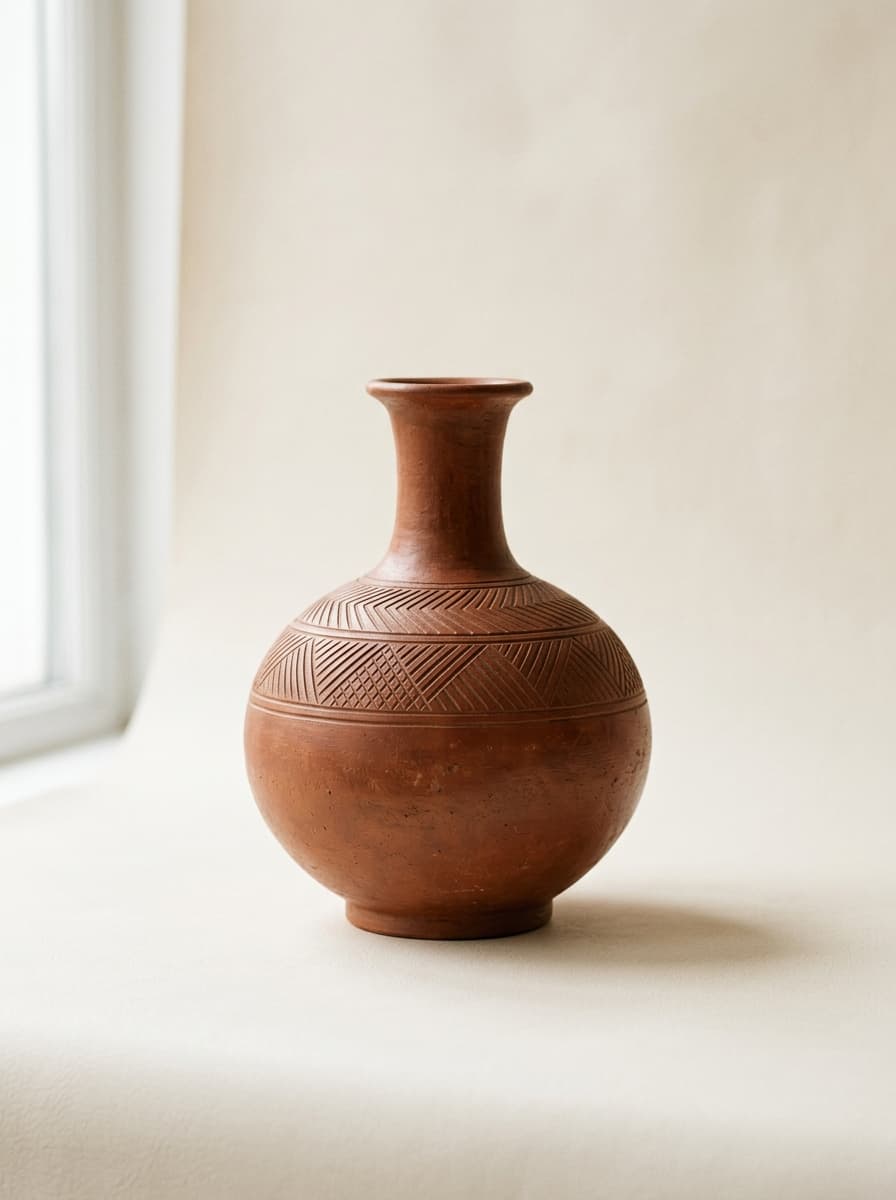
Inside the Enugu studio of sculptor Chinwe Okoli, where river-bed earthenware is burnished with smooth quartz pebbles and pit-fired with botanical leaves.
In the Studio with Chinwe Okoli
Tucked beneath the mahogany trees on the outskirts of Enugu, Chinwe Okoli's studio smells of wet loam, dry grass, and woodsmoke.
"People often assume fine ceramic finishes require high-tech gas kilns and imported glazes," Okoli remarks as she rotates a bulbous water vessel in her lap. "In reality, the women potters of southeastern Nigeria achieved a mirror-like finish for centuries using nothing more than river-washed quartz stones and patience."
Burnishing is done when the earthenware has reached the "leather-hard" stage. Over hours of rhythmic circular motion, the rounded stone compresses the clay's fine surface platelets, sealing the pores and creating a soft, tactile sheen that artificial glazes cannot replicate.
Following burnishing, the vessels are pit-fired in an open trench covered with palm fronds. Post-firing, while the vessel is still glowing with residual heat, it is submerged in a rich broth of locust bean pods and dry mahogany leaves, permanently infusing the clay with smoky amber and ebony variations.
Each vessel available through Warmthplace Art Studio carries this direct lineage: ancient material wisdom translated into contemporary architectural form.